Research Intelligence
A Structured Intelligence Layer,
Built From Fragmented Information.
The LMV Research Intelligence Framework (LMV-RIF) is the research and intelligence infrastructure behind the advisory practice. It turns fragmented source material into structured, traceable intelligence that can support analysis, challenge assumptions, identify gaps and inform senior judgement on Governance, Risk and Capital questions.
LMV-RIF supports professional judgement. The analysis, the interpretation and the decision remain with the advisor and the client.
How Research Becomes
Decision-Ready Intelligence.
RIF combines deterministic processing, semantic capabilities, recursive analysis and human judgement. Together they carry a source document through to a finding that can be traced, tested and relied on — the six stages below show how.
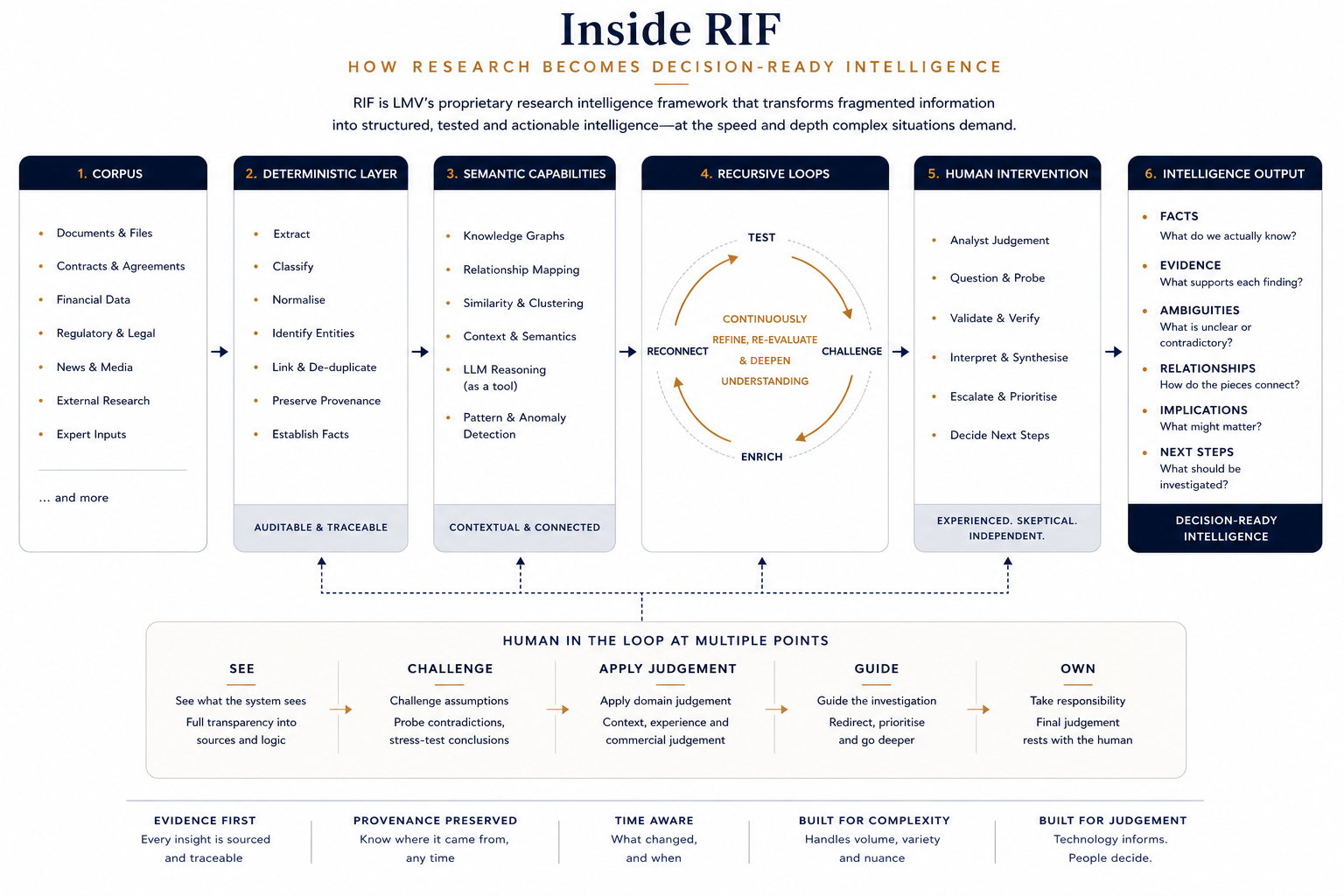
This is not a single straight pipeline. The Recursive Loops and Human Intervention stages continuously test, challenge and re-examine earlier stages before intelligence is finalised.
Corpus
- Documents & files
- Contracts & agreements
- Financial data
- Regulatory & legal
- News & media
- External research
- Expert inputs
- …and more
Deterministic Layer
- Extract
- Classify
- Normalise
- Identify entities
- Link & de-duplicate
- Preserve provenance
- Establish facts
Auditable & traceable
Semantic Capabilities
- Knowledge graphs
- Relationship mapping
- Similarity & clustering
- Context & semantics
- LLM reasoning (as a tool)
- Pattern & anomaly detection
Contextual & connected
Recursive Loops
Continuously refines & deepens understanding
Human Intervention
- Analyst judgement
- Question & probe
- Validate & verify
- Interpret & synthesise
- Escalate & prioritise
- Decide next steps
Experienced. Sceptical. Independent.
Intelligence Output
- Facts — what do we actually know?
- Evidence — what supports each finding?
- Ambiguities — what is unclear or contradictory?
- Relationships — how do the pieces connect?
- Implications — what might matter?
- Next steps — what should be investigated next?
Decision-ready intelligence
This is not a single straight pipeline. Recursive Loops and Human Intervention test, challenge and re-examine earlier stages before intelligence is finalised — the arrows above show sequence, not a one-way process.
See
Sees what the system sees, with full transparency into sources and logic.
Challenge
Challenges assumptions and stress-tests conclusions.
Apply Judgement
Brings context, experience and commercial judgement.
Guide
Redirects, prioritises and decides where to go deeper.
Own
Takes responsibility. Final judgement rests with the human.
RIF helps establish what is known, what remains uncertain, how the pieces connect, what might matter, and what should be investigated next.
Complex Decisions Generate
Fragmented Information.
A diligence exercise, a governance review or a capital decision can draw on hundreds of documents spread across legal, financial, operational and regulatory workstreams. Each domain generates its own material, reviewed by its own specialist, filed in its own place. The real difficulty is usually seeing how the material across all of them relates.
In situations like these, the relevant facts usually exist. What's missing is a structured way to see how they relate.
Material Issues Often Sit
Between the Documents.
None of the four facts below is alarming on its own. A concentrated customer base, a founder who still signs off on every material decision, a supply contract with a narrow renewal window, a growth plan built on last year's best quarter — each shows up in a different file, reviewed by a different specialist. The issue is what happens when they are read together.
Illustrative pattern, not a specific engagement.
From Source Material
to Decision Support.
Underneath that sequence sits a small set of defined objects rather than one undifferentiated pile of "information." Evidence, facts, claims, entities, relationships and events each carry their own identity and their own history, so a later reader can see not just what was concluded, but what it was built from.
Structured. Machine-Readable.
Reusable.
Entities & Relationships
People, companies, assets and agreements, each with a defined identity — and the connections between them, which is usually where the interesting questions live.
Evidence, Facts, Claims & Events
The supporting material itself, and what can and cannot yet be said to follow from it — kept as distinct, traceable objects rather than merged into a single narrative.
Risks, Contradictions, Gaps & Insights
What becomes visible once the structure and the evidence are examined together — including where sources disagree or where something is simply missing.
This structured layer supports more than one use. It can inform:
The research base is the asset. The interface used to consult it — a person, a search, a model — is secondary.
Findings Carry Their
Own History.
Each step is meant to be traceable back to the one before it — the finding to the analysis, the analysis to the fact, the fact to the evidence, the evidence to its source. Where sources disagree, where evidence is missing, or where a fact is supported but not yet certain, that is recorded alongside the finding rather than smoothed over on the way to a conclusion.
What Confidence
Actually Reflects.
Confidence
Evidence strength → Confidence
Confidence reflects how well a fact or claim is currently supported by the evidence gathered, and rises as corroborating evidence accumulates.
Uncertainty
Missing / conflicting / ambiguous evidence → Uncertainty
Uncertainty is recorded, not smoothed over — whether it comes from evidence not yet found, sources that disagree, or the limits of how a claim was derived. RIF traces each finding back to where it came from, so a reviewer can see exactly how much weight it can bear.
Four Layers, One
Research Discipline.
Framework
The governing methodology — the canonical concepts, standards and vocabulary that give every piece of evidence, every entity and every relationship a consistent meaning, independent of any one tool.
Runtime
The controlled machinery that processes structured research material against that methodology, built to produce the same result from the same inputs, run after run.
Client Harness
The engagement environment that turns a specific client mandate into a reviewable, reproducible run — setting it up, executing it, checking it, and packaging what comes out.
Intelligence Output
The structured, reviewable research package a mandate produces — ready to be examined, certified, and drawn on by the advisory work it supports.
From Client Material to a
Reviewable, Reproducible Run.
Each engagement moves through a defined sequence: material is assembled into a workspace, processed against the Framework, built into proposals, examined for consistency, reviewed at the points that call for judgement, and the resulting intelligence enriches the research base going forward. The sequence is checkpointed, so an engagement that pauses partway through resumes rather than restarts.
Where Judgement Enters,
Made Explicit.
Some steps in the process are fully controlled and reproducible — the same input produces the same output, every time. Other steps genuinely call for reasoning: weighing ambiguous evidence, resolving a contested interpretation, deciding what a gap actually means. RIF keeps that boundary explicit rather than folding a reasoning step silently into the processing chain. Where reasoning is required, the question is put in front of a reviewer, and what comes back is validated before it becomes part of the certified record.
Certain governance questions in how that review works remain open by design — among them, what additional recorded sign-off a machine-proposed conclusion should require beyond standard review — rather than settled prematurely.
A Defined Execution
and Integrity History.
Execution and certification are kept distinct. A run that completes is not automatically certified — certification is a separate, deliberate step, applied once the output has been checked for internal consistency and reconciled against what the engagement set out to produce. A failed or incomplete run is never presented as certified.
A Research Base That
Grows With Use.
A structured research base can support the next question, not only the one it was built for. A validated finding can enrich the intelligence layer; a new engagement can revisit an earlier conclusion rather than start again from source documents.
↻ back into the same structured research base
Reuse depends on provenance, currency and context: whether the source is still trustworthy, whether it's still current, and whether it has been checked again against anything that's changed since. Older conclusions are revalidated against new evidence, rather than assumed to still hold.
Research compounds.
The Intelligence Belongs to the
Research Base, Not the Interface.
Where the Framework
Applies in Practice.
The following are illustrative, generalised scenarios. They do not describe an actual client, transaction or regulatory matter. Select a case to see the full breakdown.
01 — Regulated Technology
A Growing Regulated Tech Business
Illustrative Case
Situation
A regulated tech business has scaled quickly. Its record is spread across regulatory correspondence, product documentation, board papers, customer data, financials, contracts and compliance material.
Central Problem
A product decision, its regulatory rationale, and its customer impact each live in a different file, with no reference between them.
RIF Insight
The material risk may sit between the documents rather than inside any one of them.
View the full breakdownHide the full breakdown
A Growing Regulated Tech Business
Illustrative CaseSituation
A regulated tech business has scaled quickly. Its record is spread across regulatory correspondence, product documentation, board papers, customer data, financials, contracts and compliance material.
Central Problem
A product decision, its regulatory rationale, and its customer impact each live in a different file, with no reference between them.
RIF Insight
The material risk may sit between the documents rather than inside any one of them.
Situation
A regulated tech business has scaled quickly. Its record is spread across regulatory correspondence, product documentation, board papers, customer data, financials, contracts and compliance material.
Fragmentation
A product decision sits in engineering notes and board minutes. The regulatory interpretation behind it sits in correspondence with counsel. Customer behaviour sits in a support ticketing system. None of these files reference each other.
Connection
Product decision → regulatory interpretation → operating process → customer behaviour → financial exposure.
Finding
Read together, the chain surfaces a dependency none of the individual documents shows on its own.
Implication
The material risk may sit between the documents rather than inside any one of them.
02 — Regulated Business
A Regulated Business
Illustrative Case
Situation
A regulated business operates under sector-specific regulatory requirements that touch compliance, operations and the board.
Central Problem
Regulation, internal interpretation, policy and daily practice are tracked by different teams, often on different version histories.
RIF Insight
Comparing policy versions against operating evidence surfaces where interpretation, policy and practice have quietly drifted apart.
View the full breakdownHide the full breakdown
A Regulated Business
Illustrative CaseSituation
A regulated business operates under sector-specific regulatory requirements that touch compliance, operations and the board.
Central Problem
Regulation, internal interpretation, policy and daily practice are tracked by different teams, often on different version histories.
RIF Insight
Comparing policy versions against operating evidence surfaces where interpretation, policy and practice have quietly drifted apart.
Situation
A regulated business operates under sector-specific regulatory requirements that touch compliance, operations and the board.
Fragmentation
The regulation itself, the business's internal interpretation of it, the policy documents implementing that interpretation, and the operating evidence of daily practice each live with a different team and often a different version history.
Connection
Regulation → interpretation → internal policy → operating process → evidence → board oversight.
Finding
Comparing policy versions against operating evidence surfaces where interpretation, policy and practice have quietly drifted apart.
Implication
A regulatory question typically needs evidence from several organisational layers before it can be properly examined. RIF structures that research. It does not determine compliance, and none of this constitutes legal advice.
03 — Consumer Technology
A Consumer Tech Business
Illustrative Case
Situation
A consumer tech business reports registered users, active users, paying users, revenue, cohorts, acquisition and retention across several management reports.
Central Problem
Marketing, product and finance each count "users" differently — and each number is accurate on its own definition.
RIF Insight
The numbers were never actually in conflict. They were answering different questions.
View the full breakdownHide the full breakdown
A Consumer Tech Business
Illustrative CaseSituation
A consumer tech business reports registered users, active users, paying users, revenue, cohorts, acquisition and retention across several management reports.
Central Problem
Marketing, product and finance each count "users" differently — and each number is accurate on its own definition.
RIF Insight
The numbers were never actually in conflict. They were answering different questions.
Situation
A consumer tech business reports registered users, active users, paying users, revenue, cohorts, acquisition and retention across several management reports.
Fragmentation
Marketing counts registered sign-ups. Product counts logged-in users. Finance counts paying accounts. Each number is accurate on its own definition.
Connection
Different definitions → apparent contradiction → evidence review → reconciliation → meaningful conclusion.
Finding
The numbers were never actually in conflict. They were answering different questions.
Implication
Understanding what a number represents has to come before relying on it in a decision, not after.
04 — Investment Diligence
A Proposed Investment
Illustrative Case
Situation
A proposed investment comes with management projections, customer contracts, debt documentation, property information, regulatory approvals, a cap table, historical financials and operating data.
Central Problem
Legal, financial, commercial and regulatory workstreams each review their own material and reach their own view.
RIF Insight
No single workstream's material answers the investment question on its own. The answer sits in how the pieces interact.
View the full breakdownHide the full breakdown
A Proposed Investment
Illustrative CaseSituation
A proposed investment comes with management projections, customer contracts, debt documentation, property information, regulatory approvals, a cap table, historical financials and operating data.
Central Problem
Legal, financial, commercial and regulatory workstreams each review their own material and reach their own view.
RIF Insight
No single workstream's material answers the investment question on its own. The answer sits in how the pieces interact.
Situation
A proposed investment comes with management projections, customer contracts, debt documentation, property information, regulatory approvals, a cap table, historical financials and operating data.
Fragmentation
Each workstream — legal, financial, commercial, regulatory — reviews its own material and reaches its own view.
Connection
Management plan + customer concentration + contractual restrictions + debt covenants + cap table + regulatory dependencies → the investment question.
Finding
No single workstream's material answers the investment question on its own. The answer sits in how the pieces interact.
Implication
RIF does not reach the investment decision. It gives the people reaching it a structured view of how the pieces actually fit together.
Part of How LMV
Thinks and Works.
LMV-RIF grew out of the same discipline that shapes every engagement — building recommendations to survive scrutiny after the fact, not just sound right in the room. What began as a way of organising research for a single mandate has become infrastructure that carries forward across engagements.
The sequence is simple to state and harder to build: structure the research, understand the situation more completely, and let that inform the judgement ultimately exercised on Governance, Risk and Capital questions.
How This Supports Governance,
Risk and Capital.
The Facts Behind the Structure
Governance depends on understanding how ownership, authority, decision rights and board actions actually relate to the people holding them, and whether current practice still matches what was agreed on paper.
Relationships Between Ordinary Facts
Risk often emerges from relationships between otherwise ordinary facts spread across legal, financial, operational and strategic material. RIF creates a structured basis for examining those relationships; the exposure itself remains a matter for judgement.
A Structured Base for the Judgement
Capital questions depend on how ownership, cash flows, debt, contracts, counterparties, regulation and operating assumptions actually fit together. RIF provides the structured research base; LMV provides the judgement.
RIF strengthens the research foundation from which LMV exercises professional judgement.